Museum sessions start
From 09:00
This is the start time in the published event calendar. Check available sessions for your date when choosing a ticket.
Schedule on iTicketVisit Uzbekistan calendar
Imam al-Bukhari Memorial Complex
In Khartang, near Samarkand, you can visit Imam al-Bukhari’s resting place, see the architecture of the mosque and discover the scholar’s work in the museum.
Explore the complexBefore your visit
From 09:00
This is the start time in the published event calendar. Check available sessions for your date when choosing a ticket.
Schedule on iTicketVisit Uzbekistan calendar50,000 UZS
For local visitors. Children aged 7–17: 20,000 UZS.
International visitors: adults 250,000 UZS; children 180,000 UZS.
Prices and ticketsKhartang
Khoja Ismail, Payarik district, Samarkand region. Approximately 25 km from Samarkand.
Get directionsSessions and tickets apply to the innovation museum. Confirm access times for the mosque and mausoleum before travelling.
Information checked on 12 November 2026
Architecture of the complex
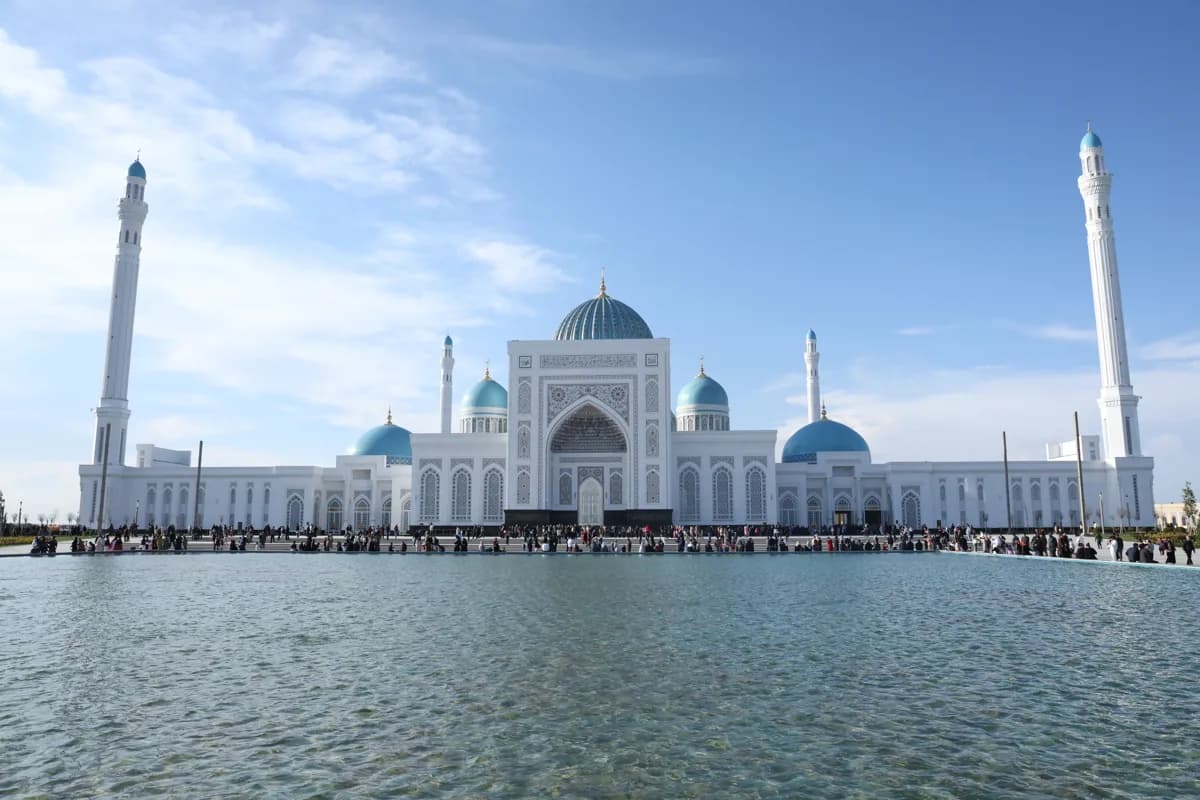
Blue domes, a pale façade and four minarets define the complex’s skyline. From across the water, you can take in the entire façade, from the central entrance to the arches on either side. Up close, look for the repeating patterns around the entrance and tall windows.
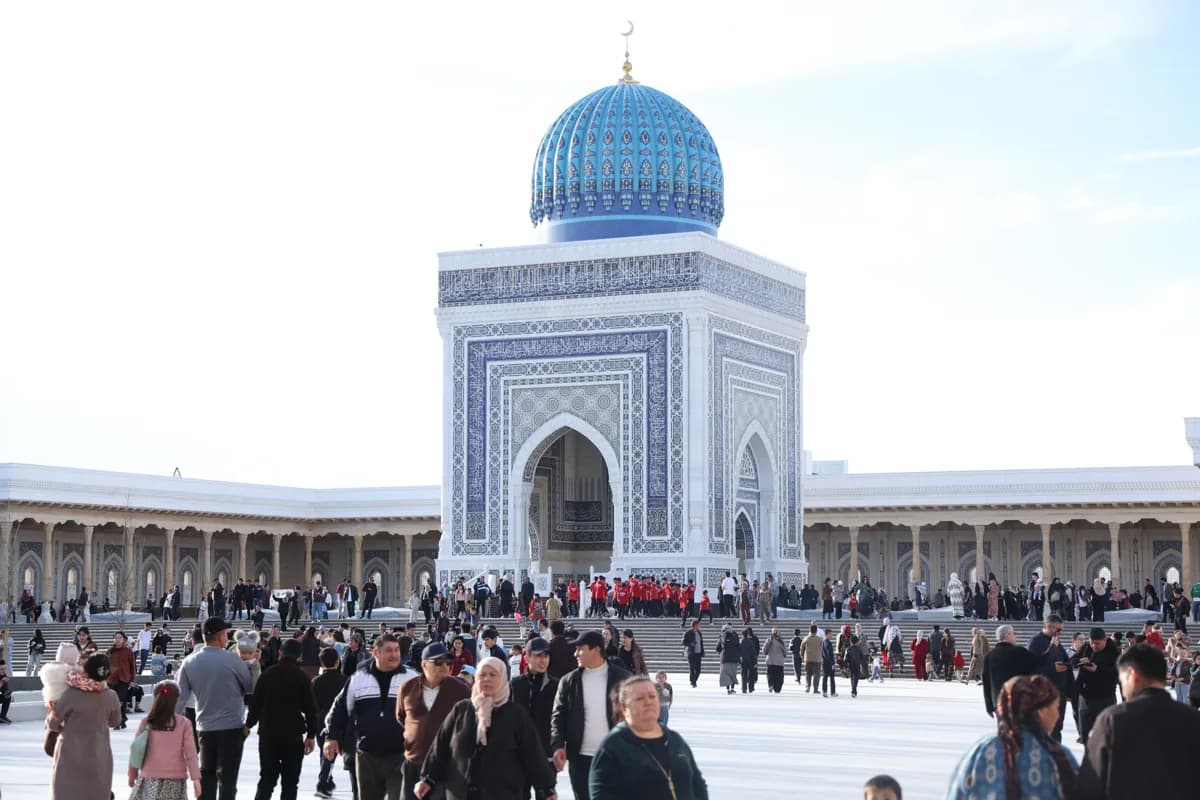
Imam al-Bukhari’s resting place stands at the centre of the complex. Its blue dome rises above the pale stone courtyard. As you approach, notice the bands of ornament framing the pointed arch and the smaller blue patterns that trace the edges of the building.
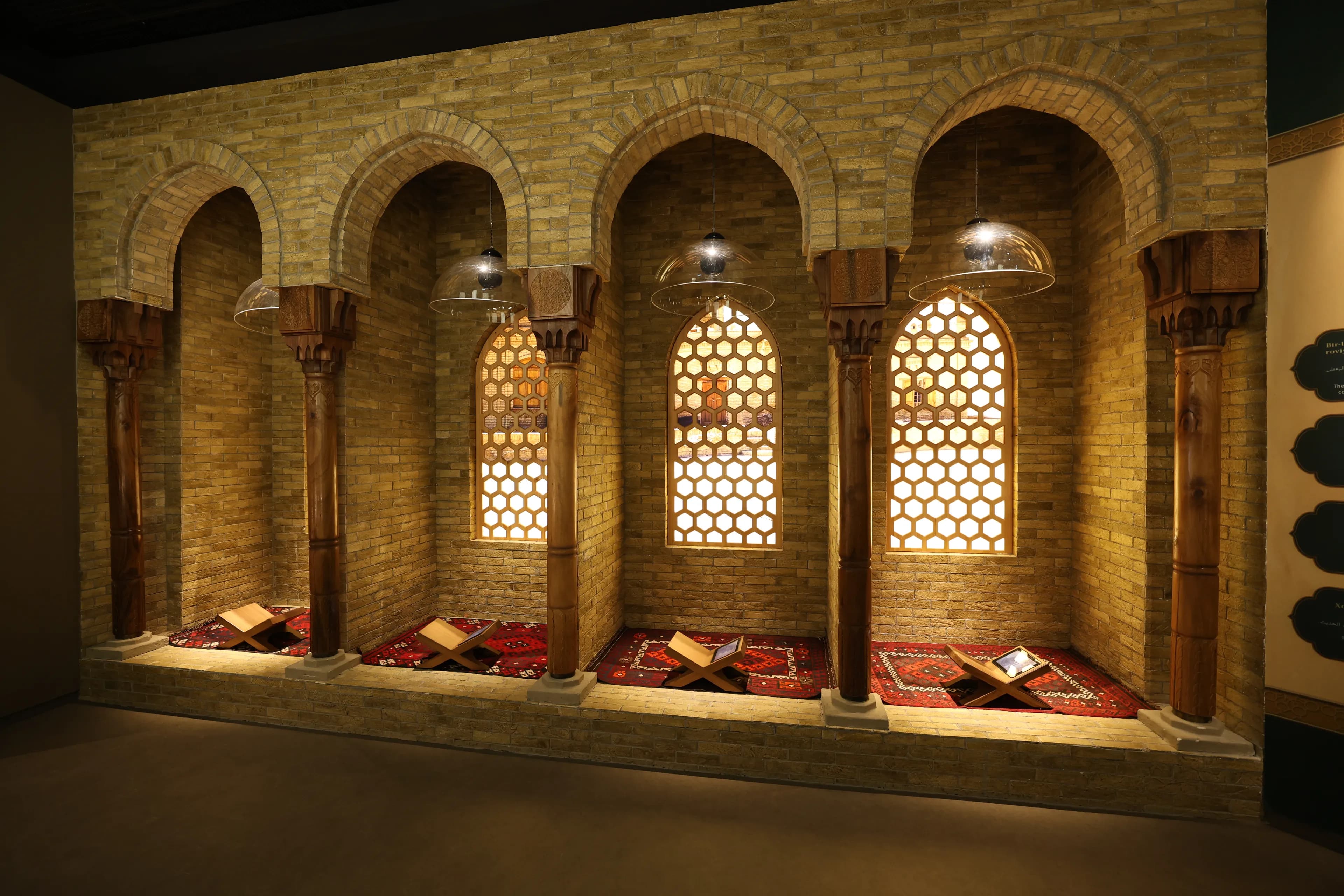
The exhibition introduces Imam al-Bukhari’s life and the practice of collecting and recording hadith. In the arched hall, warm light passes through lattice windows and falls on wooden bookstands. These details evoke the spaces where texts were read and studied.
Inside the museum
Nine pavilions explore Islamic history and Imam al-Bukhari’s scholarly legacy. Historical exhibits and modern multimedia introduce visitors to the exhibition’s themes.
Discover the 25 prophets mentioned in the Qur’an, the Prophet Muhammad’s genealogy and his life in Makkah and Madinah.
Learn how hadith — accounts of the Prophet Muhammad’s words and actions — were collected and recorded.
Explore Imam al-Bukhari’s research and contribution to Islamic scholarship. His legacy encompasses more than twenty written works.
Introducing the complex
The memorial complex was built in 1997–1998 around Imam al-Bukhari’s burial site in Khartang. It reopened in 2026 after a major reconstruction. The mausoleum remains at the centre of the complex, and the museum introduces visitors to the scholar’s life and work.
The history of this place
Imam al-Bukhari died in Khartang, a village near Samarkand, and was buried here. His burial place became the foundation of the future memorial. During the Shaybanid period in the sixteenth century, a small mausoleum and Friday mosque formed an ensemble around the grave. The history of the site therefore reaches far beyond its present buildings.
A new memorial ensemble was built for the 1,225th anniversary of the scholar’s birth, calculated by the lunar calendar. Craftspeople from Samarkand, Bukhara, Khiva, Tashkent and other Uzbek cities contributed to it. Buildings were arranged around an inner courtyard with covered galleries. This phase brought the commemoration of al-Bukhari together with living traditions of architecture and craftsmanship.
Construction under a new design began in April. The plans included a large mosque, four minarets, a broad avenue and visitor facilities. The memorial developed alongside the Imam Bukhari International Scientific Research Center and the School of Hadith Studies, bringing pilgrimage, research into historical sources and education into a shared setting devoted to the scholar’s legacy.
The renewed complex reopened to pilgrims in March. An extensive museum narrative now accompanies the place of worship, connecting al-Bukhari’s life with the development of hadith scholarship and early Islamic history. Contemporary exhibition media explain how knowledge was collected and transmitted. The scholar’s burial place remains the spiritual focus of the ensemble.
The scholar behind the name
Muhammad ibn Ismail al-Bukhari was born in Bukhara in 810. He began his education in his home city before continuing his studies in Mecca, Medina and Basra. Meeting teachers was essential to his work. Knowledge passed from one person to another, so a researcher needed to establish from whom each account had been received and under what circumstances.
Al-Bukhari was a muhaddith, a specialist in hadith: accounts of the Prophet Muhammad’s words, actions and approvals. This work involved examining both the text and the isnad, its chain of transmitters. He compared versions of reports and investigated narrators’ biographies, where and when they lived, and whether they could have met. The reliability of transmission was a subject of research in its own right; a familiar name or an appealing story was not sufficient.
His best-known collection is Al-Jami al-Sahih, also called Sahih al-Bukhari. Its compilation took sixteen years. Reports selected according to rigorous criteria were arranged by subject, from faith and worship to human relationships and ethical conduct. The collection is one of the six principal books of hadith in Sunni Islam. Understanding this method helps explain why the memorial commemorates both a person and a lasting body of scholarly work.
A living heritage
Beside the memorial stands the Imam Bukhari International Scientific Research Center. Established in 2017, it operates as a separate scholarly institution. Its remit includes studying hadith scholars’ works, collecting digital copies of manuscripts from libraries and archives around the world, and preparing catalogues and reference publications. These written sources provide a foundation for further research.
The centre studies and translates Arabic sources and preserves and restores rare manuscripts and printed books. Its work appears in monographs, teaching materials and publications for general readers. International collaboration includes conferences, seminars and exchanges with researchers working in overseas collections. The centre’s online articles and publications offer a way to continue exploring this work after your visit.
Before your visit
In Khartang, in the Payarik district of the Samarkand region, approximately 25 kilometres from Samarkand. Visiting involves a separate journey outside the city. We recommend planning both your outward and return transport, particularly if you intend to visit other sights on the same day.
Begin with an overall view of the ensemble, then spend time at the mausoleum, with the architectural details and in the museum. Each offers a different perspective: remembrance of the scholar, the work of craftspeople and an introduction to his intellectual legacy. Leave room to linger where your interest takes you.
We recommend agreeing on your visit date and group size, and checking guided-tour availability in your preferred language, current opening hours and museum admission arrangements. If you plan professional filming or a special programme, discuss those arrangements separately with your hosts before travelling.
Planning a visit
The complex is in Khartang, in the Samarkand region. Open the visit guide for directions and information to check before your trip.